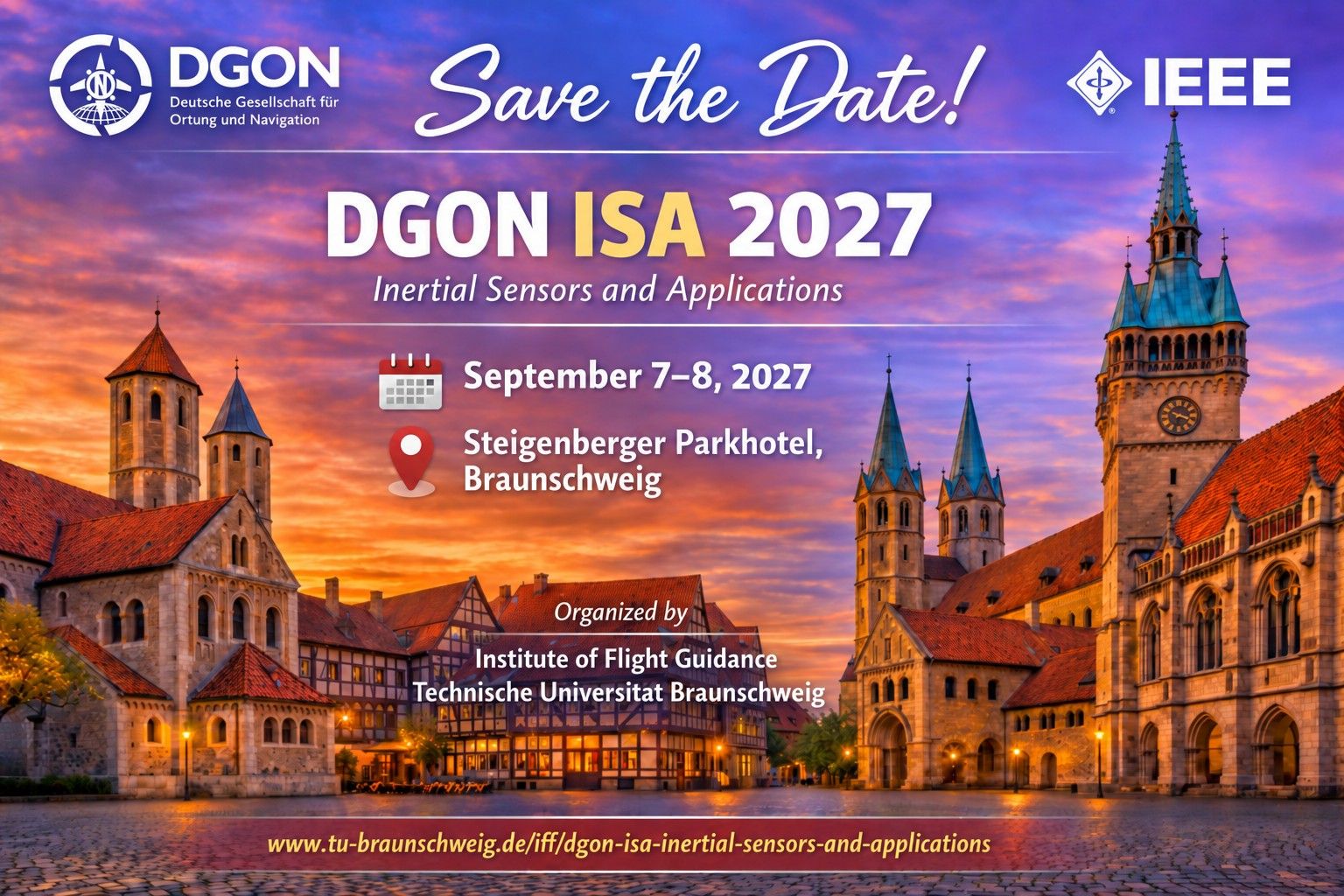
CALL FOR PAPERS 2027
DGON ISA 2027
International Symposium on Inertial Sensors and Applications
From Sensor Innovation to Real-World Performance
Bringing together research, technology, industry and applications
Braunschweig, Germany | 2027
Shaping the Future of Inertial Sensing, Navigation and Motion Technologies
Inertial sensors and systems are essential enabling technologies for navigation, positioning, guidance, stabilization, motion control and precision measurement. From autonomous vehicles and aerospace systems to robotics, industrial automation, geodetic surveying and resilient navigation, their importance continues to grow.
At the same time, emerging sensor principles, advanced manufacturing technologies, intelligent signal processing and multi-sensor integration are opening up new opportunities for accuracy, reliability, robustness and cost efficiency.
DGON ISA 2027 invites researchers, engineers, technology developers, manufacturers, system integrators and end users from around the world to share their latest advances, practical experiences and future perspectives.
With a history spanning more than six decades, DGON ISA provides an established international forum dedicated to the complete innovation chain of inertial technology — from fundamental research and sensor development to industrial products, integrated systems and real-world applications.
The conference particularly encourages contributions that bridge the gap between scientific innovation and practical implementation, address real engineering challenges, demonstrate measurable performance improvements or present new application opportunities.
Topics of Interest
Original scientific contributions, industrial developments, technical case studies and application-oriented presentations are welcome in the following areas, including but not limited to:
-
Inertial Sensor Technologies and Emerging Principles
- MEMS, FOG, RLG, HRG, vibratory and other gyroscope technologies
- Accelerometers and integrated inertial sensing devices
- Optical, photonic, atomic and quantum inertial sensors
- Novel sensing principles, materials and sensor architectures
- High-precision, miniature, low-power and cost-effective sensors
- Advances in sensor performance, stability, reliability and robustness
-
Inertial Measurement Units and Navigation Systems
- IMUs, attitude and heading reference systems (AHRS), INS and integrated navigation systems
- Strapdown navigation, alignment and attitude estimation
- High-performance and cost-optimized system architectures
- Sensor electronics, embedded processing and real-time implementation
- Navigation algorithms, estimation techniques and uncertainty management
- System integration, miniaturization and SWaP-C optimization
-
Integrated, Hybrid and Resilient Navigation
- Inertial/GNSS integration, including multi-constellation and multi-frequency solutions
- Navigation in GNSS-denied, degraded, contested and challenging environments
- Multi-sensor fusion with vision, LiDAR, radar, odometry, magnetic, acoustic RF based and other sensors
- Alternative and complementary PNT technologies
- Simultaneous localization and mapping (SLAM), visual-inertial and LiDAR-inertial odometry
- Integrity monitoring, fault detection, redundancy and resilient navigation architectures
-
Calibration, Testing, Characterization and Performance Evaluation
- Sensor and system calibration, compensation and error modeling
- Dynamic testing, motion simulation and environmental qualification
- Allan variance, stochastic processes and long-term stability
- Production testing, automated calibration and built-in test capabilities
- Metrology, traceability, standards and performance verification
- Laboratory investigations, field trials and operational performance comparisons
-
Manufacturing, Industrialization and Product Development
- Sensor fabrication, packaging, assembly and production technologies
- Design for manufacturability, scalability and reliability
- Quality assurance, lifetime assessment and lifecycle management
- Performance versus cost, size, weight and power consumption
- Technology transfer from research to industrial products
- Commercially relevant innovations, engineering trade-offs and product roadmaps
-
Signal Processing, Modeling and Intelligent Algorithms
- Advanced filtering, estimation and sensor data fusion
- AI and machine learning for sensor modeling, calibration and navigation, benefits and risks
- Adaptive error compensation and data-driven performance enhancement
- Digital twins, simulation and hardware-in-the-loop testing
- Robust algorithms for demanding operational conditions
- Real-time signal processing and embedded intelligent systems
-
Applications and Operational Experience
- Aerospace, aviation, spacecraft and launch systems
- Maritime and underwater navigation, guidance and stabilization
- Automotive applications, automated driving and mobile manned and unmanned robotics
- Rail transport, autonomous platforms and unmanned systems
- Defense, security and mission-critical navigation and PNT
- Geodesy, surveying, mapping and mobile measurement systems
- Industrial automation, machinery monitoring, precision motion control, precision farming
- Energy, infrastructure, civil engineering and emerging applications
-
Future Perspectives, Technology Trends and Engineering Challenges
- Next-generation inertial technologies and disruptive innovations
- Emerging requirements in autonomous and safety-critical systems
- Bridging laboratory performance and operational deployment
- Lessons learned from development, qualification and field operation
- Standardization, interoperability and evolving market requirements
- New application opportunities and future technological challenges
Contributions from Academia and Industry are equally welcome
DGON ISA recognizes that meaningful technological progress requires both scientific excellence and practical engineering experience.
We therefore explicitly welcome:
- Research Papers presenting novel concepts, scientific findings, theoretical advances and experimental results.
- Technology and Product Contributions describing innovative sensors, systems, architectures, manufacturing processes, solutions and performance improvements.
- Application and User Experience Papers reporting operational results, system evaluations, field trials, practical challenges and lessons learned.
- Industry Case Studies illustrating engineering solutions, integration experience, technical trade-offs and successful deployment.
- Emerging Technology Contributions introducing promising new approaches, ongoing developments and future research directions.
Contributions do not have to focus exclusively on fundamental research. Technically substantial presentations from industry and end users are particularly encouraged, including reports on developments that have already reached practical implementation.
Presentations should provide meaningful technical information and insights rather than being purely promotional.
Why Present at DGON ISA 2027?
Connect research with real-world applications. Engage directly with specialists working across the full spectrum of inertial sensing, navigation and motion technologies.
Reach a highly focused international audience. Present your developments to experts from research institutions, sensor manufacturers, system suppliers, integrators and user organizations.
Exchange experience across technology and application boundaries. Discuss technical challenges, compare solutions and explore new approaches with specialists from different disciplines and industries.
Increase visibility for your innovations. Share scientific results, advanced technologies, industrial developments and demonstrated system capabilities with a relevant professional community.
Build new partnerships. Identify opportunities for research collaboration, technology transfer, industrial cooperation and future applications.
Submit Your Contribution
Authors from universities, research institutes, industrial companies, government organizations and end-user communities are invited to submit abstracts for consideration by the International Programme Committee.
Abstracts should clearly describe the technical subject, its relevance, the approach taken and the principal results, innovations or practical insights to be presented.
Both scientific and application-oriented contributions will be evaluated with regard to technical relevance, originality or practical value, and their potential contribution to professional knowledge exchange.
We look forward to your contribution to DGON ISA 2027 — where inertial technology meets real-world applications.
Submission Deadline: May 21, 2027
Notification of Acceptance: June 28, 2027
Conference Date. September 7-8, 2027 – Braunschweig, / Germany
Deadline of final Paper Submission: September 7, 2027
Organized within the framework of the German Institute of Navigation (DGON) and IEEE.